New: Meet DOBI, the AI assistant for lifecycle engagement. Learn more →

New: Meet DOBI, the AI assistant for lifecycle engagement. Learn more →

Article

7
min read

Co-founder, Chief Executive Officer
Community banks and credit unions spend about $6 on services for every $1 of software. As you plan 2027, the better move is to stop buying platforms and start buying outcomes.
Most technology decisions start with a goal: grow deposits, keep new accountholders, sell the next product. Then a platform gets bought in the hope it will get you there.
A year later, the story is familiar:
So the consultants come in. Even after that spend, results often fall short.
“We moved to a new marketing automation platform because we thought we needed better reporting. More than a year and many consulting hours later, we still couldn’t clearly identify the outcomes it was intended to drive. Now, we’re working to define those outcomes and track them with Digital Onboarding.”
Heidi Kassab, President/CEO, Cornerstone Community Financial Credit Union
U.S. financial services will spend about $495B on technology in 2026, and roughly 40% of that, about $200B, goes to software (Forrester). FinTop estimates the services spend that AI can now take on at about $1.25T. That’s roughly $6 of services for every $1 of software.
The same ratio shows up well outside banking. IDC estimates Salesforce’s partner ecosystem earns $5.60 for every $1 Salesforce makes today, rising to $6.93 by 2028 (IDC via Salesforce). For HubSpot, IDC sizes the partner ecosystem at $13.7B in 2025, heading to $36B by 2029 (IDC via HubSpot).
For a community FI, the math is simple. You pay for a platform that can’t deliver the result on its own, or you pay for the platform plus six times more to make it partially work.
AI changes that equation. Much of the services work, building audiences, writing content, running campaigns, reading the results, is exactly what AI now does well. The question is no longer “which platform should we buy?” It’s “which outcome do we need, and can we see it happen?”
It’s tempting to think AI agents can simply run the tools you already have. The numbers say otherwise.
FinTop shared the example of a 200-person financial institution with 80 key vendors. Managing each system with AI would take 30 to 40 agents, or roughly 3,000 agents in total. That’s about 15 agents for every employee. AI doesn’t remove the cost of a fragmented stack. It multiplies the work of managing it.
Most community FIs carry $150K to $400K a year in marketing and engagement tools across separate vendors, before the services to stitch them together:
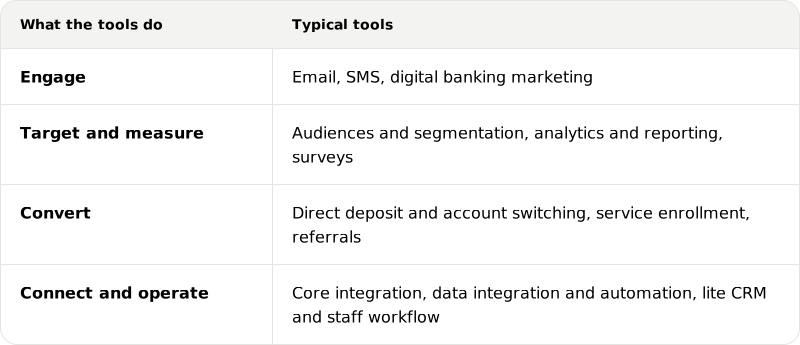
Each of those tools has its own data, its own reporting and its own definition of success. Outcomes don’t come from adding one more point solution. They come from consolidation.
The outcomes community FIs are budgeting for fall into three groups. Pick the ones that matter most, then hold your platform accountable for moving and tracking them.
Acquisition
Retention and PFI
Expansion
Across the cross-sell campaigns our FIs run, four products lead: checking (19%), auto loans (17%), credit cards (10%) and HELOC and home equity (8%). Mortgage, savings, personal loans, CDs and money market follow.
If those are your goals, don’t start with the platform. Start with the outcome, and how you’ll see it happen.
When the outcome is the goal, the results are measured in accounts, primacy and loans, not opens and clicks.
Most FIs come to us knowing they have a problem. It might be attrition, first-year churn, or profitability they can’t see clearly. They know it’s there, but they can’t see where.
Finding that problem and tracking the outcome shouldn’t cost thousands of dollars. And it definitely shouldn’t cost six times the software fee.
Alpena Alcona Area Credit Union is a good example. When they looked at their direct deposit data, they found most switch attempts were for Social Security, and members were abandoning them. The easy fix was a second vendor. Instead, they solved it inside the platform they already had.
“What jumped out to me was that the majority of the attempts for ACH were for Social Security. And we had a lot of abandonment, failure, and bad credentials.”
Alicia Payne, Digital Operations Specialist, Alpena Alcona Area Credit Union
Technology should make it easier to execute campaigns, not create more work for your team. With the right tools and support in place, financial institutions can scale engagement without adding complexity.
“It’s really been a game changer for our team because it’s so scalable and hands off.”
Kat Rembacki, Head of Marketing, One Detroit CU
When data, engagement, and conversion tools work together in one platform, financial institutions can eliminate unnecessary complexity and take action without relying on disconnected systems.
“Digital Onboarding has a clear competitive advantage over other ESPs because of the widgets you incorporate into the messages and your ability to write to the core. This is why we jumped ship from [a legacy enterprise platform], a platform we were comfortable with and had 10 years of experience using.”
Steven Gillen, Marketing Technology Leader, OCCU
If the answers point to more tools, more consultants and more guesswork, it’s time to change the question.
That’s what Digital Onboarding is built for. One platform brings email, SMS, digital banking marketing, audiences, conversion tools and core integration together, so every engagement draws on the same data. DOBI, the AI agent inside the platform, builds the audiences and content and keeps the focus on the outcome you set out to achieve.
“We’ve cranked out a few touch points and we’re a fan of DOBI.”
Jared Sheldon, Customer Lifecycle Specialist, First Fidelity Bank
This budget season, invest in outcomes, not software.

68 Harrison Ave, #605, PMB 42644
Boston, MA 02111
68 Harrison Ave
#605, PMB 42644
Boston, MA 02111
© 2025 Digital Onboarding, Inc.

© 2026 Digital Onboarding, Inc.


